A chair carton fits a storage bay only when three numbers agree: the carton’s outside length and width against the shelf’s clear opening, and the carton’s height multiplied by the planned stack count against the clear height under the shelf above. Measure the bay first, then the carton, and leave working clearance at the sides and front. If the carton cannot be stacked to at least two high inside the bay, it will spend its time in the aisle, which is the outcome you are trying to prevent.
The practical question behind “chair packaging size storage bay” is best answered with room measurements, construction details, and the chair’s intended use considered together.
The decision usually comes down to two formats. An assembled chair ships in a large carton that is often too tall to stack more than one high but needs no labor on arrival. A knocked-down chair ships in a flatter, denser carton that stacks well and stores compactly but adds an assembly step and a second handling point. Neither is universally better. The right choice depends on your bay dimensions, your receiving labor, and how quickly the stock turns.
What follows is a practical method: measure the bay and the carton the same way, test stack height before you commit to a purchase order, and decide between assembled and knocked-down formats using the numbers rather than habit.
The short answer: match the carton envelope to the clear bay, not the nominal shelf
Retail back-room shelving is usually quoted by nominal width and depth, but the usable opening is smaller. Uprights, beam flanges, and safety lips eat into the clear space. A bay sold as 1,200 mm wide may give you 1,150 mm between uprights, and a shelf sold as 600 mm deep may give you 560 mm of usable depth once the front lip is counted. Cartons must be checked against the clear opening, not the catalogue figure.
The second number that matters is stack height. Most back-room shelving is rated per shelf level, and the clear height between levels is fixed by where you place the beams. If a chair carton is 900 mm tall and the clear height is 1,800 mm, you can stack two high. If the carton is 1,000 mm tall, you can still stack one, but the second will not fit, and the overflow goes to the floor or the aisle.
So the practical rule is: clear opening width and depth must each exceed the carton by a handling margin, and carton height multiplied by the intended stack count must be less than the clear height. If either test fails, change the format, the bay configuration, or the order quantity.
Why cartons end up in the aisle, and where the limits sit
Nominal versus clear dimensions
Almost every receiving problem starts with a nominal measurement. A bay described as 1.2 m wide with 0.6 m shelves sounds generous until you subtract uprights, beam ends, and a lip. Measure the clear opening at the widest point between uprights and at the deepest point from the back panel to the front edge of the shelf. Do this at the actual shelf level you plan to use, because beam positions vary.
Record the smallest clear figure across the bay, not the average. A slightly out-of-square bay or a protruding bracket can reduce the opening by 20–30 mm at one corner, which is enough to stop a carton sliding in.
Stack height and shelf load ratings
Shelving load ratings are usually stated per level for evenly distributed weight. A stack of chair cartons is a concentrated load at the base, and the cartons themselves carry compressive load. Two cartons stacked are not twice as safe as one; the bottom carton takes the weight of everything above it. Check the carton’s stated stacking limit, often printed as a maximum stack number, and treat it as a ceiling rather than a target.
Verify the shelf rating from the shelving supplier’s documentation and the carton stacking limit from the carton print or the supplier’s specification sheet. If neither is available, stack conservatively and inspect the bottom carton for compression after a week.
Access and turning space
A carton that fits the bay but cannot be turned in the aisle in front of it is still a problem. Allow at least the carton’s diagonal plus a comfortable margin for the turning swing. For a 1,100 × 700 mm carton, the diagonal is about 1,300 mm, so a 1,500 mm aisle is workable but tight with a pallet truck.
When the format itself is the limit
Assembled lounge chairs are often packed with the frame upright, producing a tall carton. Knocked-down chairs pack frame, seat, and legs flat, producing a lower, denser carton. The limit is rarely the chair; it is the carton envelope the factory chose. Ask for carton dimensions before ordering, not after the delivery note arrives.
How to measure the bay and the carton the same way
Consistency matters more than precision. Measure both the bay and the carton with the same tape, in the same units, and record the smallest figure for each dimension. Metric and imperial mixing is a common source of receiving errors, especially when a factory quotes millimetres and a store plan is in inches.
Measuring the storage bay
Take four readings per bay: clear width between uprights, clear depth from back to front lip, clear height from shelf surface to the underside of the beam above, and the aisle width in front. Note any obstruction such as a column, sprinkler riser, or electrical box. Photograph the bay with the tape in frame; it settles arguments later.
Measuring the carton
Carton dimensions are conventionally given as length × width × height, but confirm the order with the supplier. Measure the outside of the carton, including any bulge from packing, and add the pallet height if the carton ships palletised. A carton described as 1,000 mm long may measure 1,020 mm at the seams.
Check the carton’s orientation marks. A “this way up” carton cannot be stored on its side to fit a shallow shelf without risking damage to the chair, so the height dimension is fixed. If the carton must stay upright, the stack-height test becomes the binding constraint.
Calculating usable capacity
Usable capacity per bay is the number of cartons that fit across the width, multiplied by the number that fit front to back, multiplied by the number that stack. Work it out for one bay, then multiply by the number of bays you can dedicate. Compare that figure with your expected delivery quantity. If a single delivery exceeds capacity, the surplus will sit in the aisle until it sells.
| Measurement | Where to take it | Typical error to avoid | Pass condition |
|---|---|---|---|
| Clear bay width | Between uprights at the chosen shelf level | Using nominal width from the plan | Carton width + 50 mm minimum |
| Clear bay depth | Back panel to front lip | Ignoring the front safety lip | Carton depth + 30 mm minimum |
| Clear height | Shelf surface to beam underside | Measuring to the ceiling instead | Carton height × stack count + 40 mm |
| Carton outside dimensions | Widest point, including seams and pallet | Using factory nominal figures only | Measured figure within 20 mm of spec |
| Aisle turning space | In front of the bay, at floor level | Ignoring equipment width | Carton diagonal + 200 mm |
Materials and construction: what the carton is protecting
The carton’s size is driven by what it must protect. A fully upholstered lounge chair with a rigid frame needs clearance around arms and back, plus corner protection and often a foam or moulded insert. That structure adds bulk. A chair with a slimmer profile and flat-pack joinery can be packed in layers, which reduces volume and improves stackability.
Corrugated board grade matters for stack height. Double-wall board resists compression better than single-wall, and a carton with internal corner blocks holds its shape under load. If you plan to stack three high, ask for the board grade and the stacking limit rather than assuming the carton will cope. Verify by inspecting a delivered carton for crush at the bottom corners after a week in the bay.
Upholstery choice affects packing too. Heavier fabrics and deep cushioning increase the packed height, while tighter tailoring and removable cushions can reduce it. If you are weighing fabric options against storage constraints, the guidance on chair upholstery fabric selection explains how fabric weight and construction change the finished form, which in turn changes the carton.
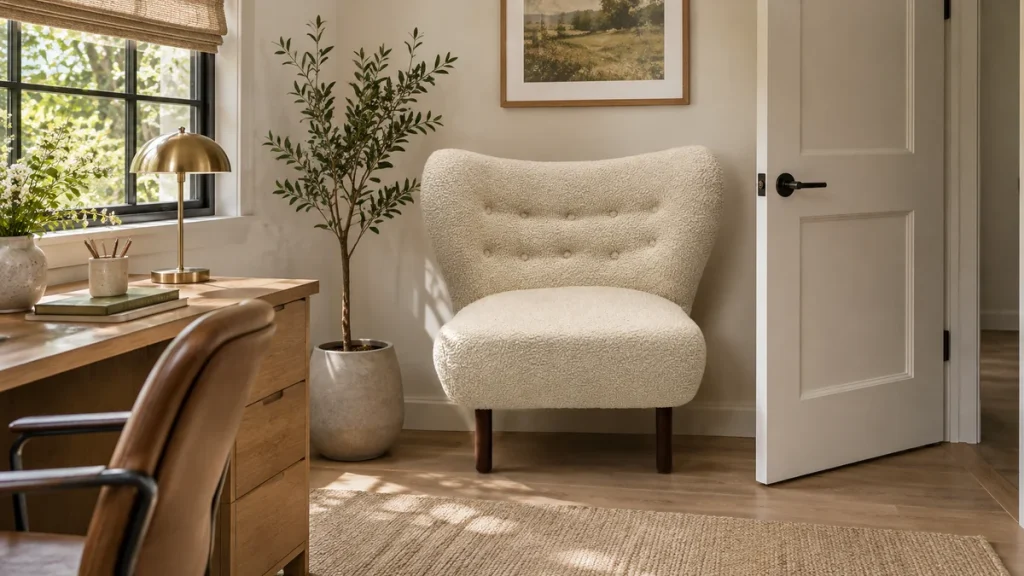
For a specific example of how a sculptural, fully upholstered form translates into packed volume, the upholstered sculptural lounge chair page shows the kind of product where the carton is likely to be tall and wide rather than flat. That is not a flaw; it is a consequence of the shape. The point is to know it before you allocate bay space.
Assembled versus knocked-down: when the extra assembly step earns its place
Knocked-down formats earn their extra assembly step when storage height is the binding constraint. A flat carton that stacks four high in a bay can hold four times the stock of a tall carton that stacks once. If your back room is short on height and long on floor area, flat packing is usually the better fit.
Assembled formats earn their place when receiving labor is scarce or when the chair must go straight to the floor. A chair that arrives ready to place avoids a build station, tooling, and the risk of assembly damage. If your bay can take the tall carton and your stock turns quickly, the assembled format may be simpler overall.
The trade-off is not only labor. Knocked-down cartons need a clean, dry assembly area and a place to stage part-built chairs. They also need hardware control, because a missing bolt stops a sale. Assembled cartons need more bay height and more careful stacking. Weigh both against the constraints you actually have.
What assembly adds to the receiving process
Assembly adds a step between goods-in and the shop floor, and that step needs space. A build bench, a tool kit, and a staging area for completed chairs all compete with storage. If the build area is the aisle, you have moved the problem rather than solved it.
Assembly also changes the inspection point. Damage that would be hidden inside a sealed assembled carton becomes visible when parts are unpacked. That can be an advantage, provided you record it at the build station rather than discovering it on the shop floor.
Decision process: a step-by-step way to choose
Work through these steps in order. Each one can eliminate an option before you spend time on the next.
Step 1: Fix the bay configuration
Decide which bays you can dedicate to chairs and set the beam heights. Record clear width, depth, and height for each. If you can adjust beam positions, model two configurations: one for tall cartons and one for flat cartons.
Step 2: Get carton data before the purchase order
Ask for outside carton dimensions, carton weight, stacking limit, orientation requirement, and whether the carton ships palletised. Confirm the dimension order. A supplier who cannot provide these figures is a risk to your receiving plan.
Step 3: Run the fit test
Apply the pass conditions from the measurement table. If the carton fails on height, try a different beam position or a different format. If it fails on width or depth, the bay is wrong for that carton, and no amount of stacking will fix it.
Step 4: Calculate capacity against delivery size
Multiply cartons per layer by stack count to get bay capacity. Compare with the largest single delivery you expect. If capacity is short, either reduce order quantities, add bays, or choose a denser format.
Step 5: Check the handling route
Walk the route from the loading door to the bay. Measure door widths, lift dimensions, and turning points. A carton that fits the bay but not the lift still ends up in the corridor.
Step 6: Confirm the format decision
Choose assembled if the bay takes the tall carton, capacity meets delivery size, and labor is tight. Choose knocked-down if height is the constraint and you can support a build station. Record the reasoning so the next order does not reopen the question.
Comparison table: assembled versus knocked-down cartons in a retail bay
| Factor | Assembled carton | Knocked-down carton | How to verify |
|---|---|---|---|
| Typical carton height | Tall; often 850–1,100 mm for lounge chairs | Low; often 200–450 mm | Supplier spec sheet and a tape on the first delivery |
| Stack count in a 1,800 mm clear height | Usually one, sometimes two | Three to six, subject to carton limit | Divide clear height by carton height, then check the carton limit |
| Receiving labor | Low; unload and place | Higher; unpack, assemble, inspect | Time a sample build and multiply by delivery quantity |
| Build space needed | None beyond unpacking | Bench plus staging area | Confirm the bench is not in the aisle |
| Damage visibility | Hidden until unpacked on the floor | Visible at the build station | Record condition at the point of unpacking |
| Best fit when | Height is available and stock turns fast | Height is short and floor area is available | Re-run the capacity calculation for both formats |
Use cases: matching format to the room behind the shop
Small boutique with one narrow bay
A single bay of 1,000 mm clear width and 500 mm clear depth will not take a wide assembled carton. A knocked-down carton in the 950 × 450 mm range leaves a handling margin and stacks several high. The build bench can sit in a back office if the route is clear. This is the classic case where the extra assembly step earns its place.
Hotel or hospitality store with palletised deliveries
Palletised assembled cartons need floor space and a pallet truck route. If the bay is deep and the clear height is generous, two-high stacking on the pallet may work, but check the carton stacking limit and the shelf rating together. Where deliveries arrive in large batches, calculate capacity against the pallet quantity, not the individual carton.
Design studio holding samples
Sample chairs are usually one or two units, so capacity is not the issue. Access is. A tall carton that fits the bay but blocks the shelf behind it will be moved constantly. Store samples in a bay with clear front access, or choose a format that can be stored on its side if the chair allows it.
Multi-site retailer standardising bays
Standardise the bay configuration first, then specify carton limits in the purchase agreement. A carton envelope maximum, stated as length × width × height, is easier to enforce across suppliers than a chair description. Verify against the first delivery at each site and record the measured figures.
When you are comparing several chair ranges for the same bay, the full chair collection is a useful starting point for identifying which formats are likely to ship flat and which will arrive assembled. Use the carton data, not the product photo, to make the final call.
Buyer checklist: pass, fail, or verify before the order
Use this list at the quotation stage. Any “fail” should stop the order until it is resolved; any “verify” should be confirmed in writing.
| Check | Pass condition | Fail condition | Status |
|---|---|---|---|
| Carton width versus clear bay width | At least 50 mm spare | Less than 20 mm spare | Pass / Fail |
| Carton depth versus clear bay depth | At least 30 mm spare | Carton overhangs the lip | Pass / Fail |
| Stack height | Two or more high within clear height | Only one high fits | Pass / Verify |
| Carton stacking limit | Stated and equal to or above planned stack | Not stated by supplier | Verify in writing |
| Shelf load rating | Rated for full stack weight | Rating unknown or exceeded | Verify from shelving documents |
| Bay capacity versus delivery size | Capacity equals or exceeds largest delivery | Surplus will sit in the aisle | Pass / Fail |
| Handling route | Carton passes doors, lift, and turns | Any pinch point narrower than the carton | Pass / Fail |
| Build station for knocked-down stock | Bench and staging outside the aisle | Build would happen in the aisle | Pass / Fail |
Maintenance and keeping the bay workable over time
A bay that works on day one can fail by month three. Cartons settle, shelves bow, and delivery sizes creep upward. Set a simple routine: inspect the bottom carton of each stack weekly for crush or leaning, check that nothing overhangs the shelf lip, and confirm that the aisle is clear at the end of each receiving day.
Re-measure the clear height after any change to beam positions. A beam moved down by one notch can turn a two-high stack into a one-high stack. Keep a note of the carton dimensions and the bay dimensions together, so the next order can be checked without repeating the survey.
Repair limits matter here. A carton that has lost its corners will not stack safely, and tape will not restore compression strength. Remove crushed cartons from the stack and inspect the chair inside. If the chair is sound, repack it in a fresh carton or store it singly. Do not place a damaged carton at the bottom of a stack.
For questions about specific carton figures, delivery formats, or bay planning for a particular order, the trade team contact page is the place to confirm details before committing.
Verification: proving the fit before the stock arrives
Verification is the step most receiving plans skip. Ask for a sample carton, or the exact carton dimensions in writing, and test them against the bay before the main delivery. A sample carton is the cheapest way to discover that the nominal width was optimistic.
Where a sample is not available, verify with measurements plus documentation: the supplier’s carton spec sheet, the shelving load rating, and a photograph of the bay with a tape measure in frame. Compare the figures yourself rather than relying on a summary.
On the first delivery, measure three cartons from different positions in the load. Cartons at the bottom of a pallet may be compressed, and cartons at the top may be bulged. Record the largest measured figure and update your bay plan if it differs from the spec by more than 20 mm.
Finally, check the chair itself against the display space. Carton fit solves the back room; the chair still has to suit the floor. The seat height and ergonomics guide helps confirm that the chair you have stored so efficiently is the right one for its intended setting, and the lounge chair dimension reference gives the finished measurements to compare with both the display area and the unpacked footprint.
Conclusion
Chair packaging size and storage bay fit come down to three clear measurements taken the same way on both sides: width, depth, and stack height. Measure the clear opening rather than the nominal shelf, multiply carton height by the stack count, and compare bay capacity with your largest delivery. If the tall assembled carton will not stack twice, the flat knocked-down carton usually earns its extra assembly step, provided you have a build station outside the aisle. Verify with a sample carton or written dimensions before the order, and re-check on the first delivery.
FAQ
How much clearance should I leave around a chair carton in a storage bay?
Allow at least 50 mm of spare width and 30 mm of spare depth so the carton can be slid in without scraping the uprights or catching the front lip. Leave 40 mm above the top of the stack for lifting and inspection. These margins are practical minimums, not standards; tighter fits slow down receiving and increase damage risk.
Can I store a “this way up” carton on its side to fit a shallow shelf?
Only if the supplier confirms the chair can tolerate that orientation. Orientation marks usually protect the frame, arms, or upholstery from load and distortion, and laying the carton down can put weight where the chair was not designed to take it. If the shallow shelf is the constraint, choose a flatter carton format instead of rotating a tall one.
How do I work out how many chair cartons fit in one bay?
Divide the clear bay width by the carton width, the clear depth by the carton depth, and the clear height by the carton height, rounding down each time. Multiply the three results. Then check that the total does not exceed the carton stacking limit or the shelf load rating. Compare the result with your largest expected delivery.
Why does a knocked-down chair sometimes take more storage space overall?
Because assembly needs a bench and a staging area for part-built chairs. If those sit in the aisle or a corridor, the flat carton’s savings are cancelled by the space the build process occupies. Knocked-down formats work best when a dedicated build area exists outside the storage and circulation routes.
What should I do if the carton dimensions on the delivery differ from the spec sheet?
Measure three cartons from different positions in the load and record the largest figure. If the difference is more than about 20 mm, re-run the fit test against the bay before placing the stock. Report the discrepancy to the supplier in writing and ask for corrected carton data for future orders.
Is a taller carton always worse for a retail back room?
No. A tall carton that fits the clear height and stacks two high can be more efficient than a flat carton that needs a build station. The deciding factors are clear height, stack limit, delivery size, and available labor, not carton height on its own.